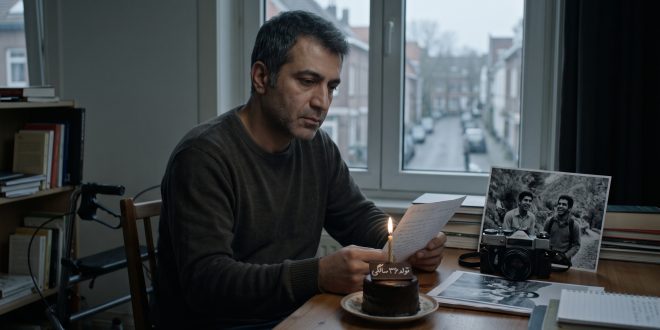
Hamed to Saber · Dated 18 September 2026; published on the Persian site on 19 September 2026
Hello Saber,
Your letter from Rasht has reached me. According to the calendar, today is my birthday, and I am entering my thirty-sixth year. It is not that birthdays or numbers matter much. But, as people on engineering projects would say, a birthday can serve as a milestone: a way of finding out where you stand.
A few days ago I noticed several white hairs. Perhaps that is why it occurred to me that, from this point onwards, I will not be getting younger. I will be getting older.
I think our thirties are a decade of acceptance and difficult admissions. These days I know that I will probably never have children, and may never even marry. I know that I may not return to my country for years. I know that justice has never really existed in this world as fully as it should.
I admit that I know I am unlikely to do anything extraordinary in the life ahead of me, or even necessarily enjoy being here. And I admit that, of all my so-called achievements, the tea we drank in Darband and the photograph you took with your old camera, in that old-fashioned style, gave me more pleasure.
As a teenager, you want to change the world. You imagine that by thirty you will have travelled halfway around it, found the great love of your life, and had several children. Along the way, you will have patched the world’s holes and made it a place worth living in. By forty at the latest, there will be nothing left to do except watch your grandchildren grow up.
The distance from fifteen to thirty is so much greater than the distance from thirty to seventy. Perhaps life has not yet shown us its hand, and we are still happily playing its guessing game. By forty, you know that both its hands are empty.
Our twenties are the decade of ideals. We are prepared to die for them. Dying in bed seems almost cowardly. Then we grow older and cling more tightly to life. We bury ourselves in titles, become more interested in reform, and want everything to proceed step by step.
But the young have no time. The world has too many holes, and they have to fix them all by thirty before turning to their families. Contrary to what people say, the young do not have much time. That is why they keep dying in such a hurry, while the old live longer and longer.
I admit that when you come from a place where an eighteen-year-old is waiting to be executed, life can lose much of its attraction. When you know that a young woman has lost her eyes for freedom, you can find yourself unable to look at freedom. When thousands of young people have been killed, you can even feel ashamed of your own life.
I admit that, on many days, I compare my age with the ages of those we remember as the immortal dead, and realise how much longer I have lived.
These days I have accepted that the world is not a fair place, and that history’s killers will not necessarily pay for what they have done. So I walk slowly, like an old man. I keep looking back to see how far I have come, then look ahead to take stock of the road, while young people run past me towards the finish. I can only watch.
I write more now, and read more, even as time runs away from me. Yet I feel that we must keep writing and keep moving along the road, even if we need a walking frame.
27 Shahrivar 1405 · 18 September 2026
Darband is a mountain neighbourhood of Tehran, associated with walking, cafés and tea. The “empty hands” image refers to a guessing game in which one player hides an object in a fist.