Hamed to Saber · Written in Sydney on 2 October 2026; published on the Persian site on 4 October 2026
Dear Saber,
As always, I read your letter with all my heart. Today I realised that we have written more than ten letters to one another. I wonder whether we would have taken up our pens and written so recklessly if circumstances had been different.
I think that when a person dies often enough inside, fear gradually loosens its grip. You put censorship aside and take up the pen, even if blood drips from it.
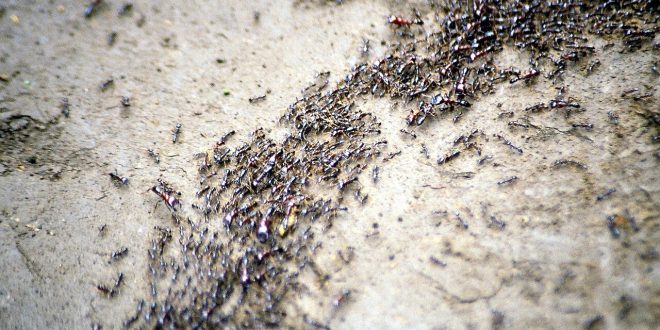
You wrote about ants. Strangely enough, I had been thinking about ants myself a few days ago.
As a child, I would take the garden hose and go looking for them. I would drown them, but always make sure a few survived. I wanted the survivors to value their lives more, to stop being trapped in endless labour. I wanted their lives to change, for them to stop repeating what everyone else did. To understand how easily life could end, and therefore live as they wished.
Perhaps they would return to their colony and say, “You miserable ants! How much longer will you remain prisoners of this life? How much longer will you carry grain to the queen so she can live off your work?”
Perhaps they would become revolutionary ants and rise against her. Perhaps the soldier ants would kill them. But at least they would die for freedom.
Or perhaps they could overthrow the queen and all be free. Though I do not know whether replacing her would really improve their situation.
Some ants might say that ant society was not yet ready for change: the ants must first change within themselves. The ant bourgeoisie would look down on the others and argue that these workers’ uprisings would lead nowhere because they lacked an adequate theoretical foundation.
But to ants whose share of grain kept shrinking, such arguments would mean nothing. Soon enough, they would starve.
The queen would probably announce that things were not really so bad. These problems were the result of sanctions imposed by humans, who were preventing enough grain from reaching everyone. Then she would describe how much worse things were in other colonies.
The ants close to the queen would explain that they all lived in the same colony: if the water swept them away, everyone would drown together.
But ants are not fools. Among themselves they would ask why only their own share of grain was shrinking, while the queen’s inner circle grew fatter by the day.
They would say it quietly, of course. The queen had spies everywhere. And she was, after all, their mother. It simply seemed that some children were loved more than others, while some had never been wanted.
I do not know what became of the ants that survived. Perhaps they really did rise up. Perhaps they returned to their old miserable lives. Perhaps they decided they needed a different queen and emigrated from their colony.
I do not know how immigration works for ants. If they move to another colony, can they still visit their friends? Or will they be drowned on charges of spying for another queen?
Even their old friends might see them as enemies and cut them off. “You are no longer one of us,” they might say. “You have no right to speak about our problems. This is an internal dispute. We do not want help from anyone else.”
I am sure the migrant ants would miss their own colony. Perhaps they would even write letters to one another. At night, they would remember their days of labour with their friends and ask themselves, “Was it worth it?”
“Yes, the queen was cruel,” they would say, “but my friends are still there.”
They would remember. They might have a drink alone and celebrate a birthday alone, then think of the days when their friends gathered in the colony and made a celebration out of a single little grain.
Perhaps they would wish I had drowned them that day, so they would never have had to live through this.
I wish I had not drowned those ants. I wish I had not tried to make their lives better. The ants that survived are not doing better. They are wrestling with a thousand troubles, large and small.
You asked whether the good things we did for ants could erase the wrong of killing the others. I think that however much food we give them, they will not feel better. They will keep thinking about their friends, about how happy they would be together if those friends were still here, even with only a single grain on the table.
We can give them all the sugar we like. It will make no difference.
So my answer is this: some things cannot be put right.
I have talked so much about ants that I forgot to ask how you are.
There is no news here either. I do not mean that metaphorically. I mean that “news” here is somebody’s house being burgled, or a fight in the street. Things we would not even consider an interesting anecdote become a television report.
I do not know why colonies should differ so much. But there must, of course, be some divine calculation that you and I have yet to understand.
Until we meet again,
Hamed
Sydney · 10 Mehr 1405 · 2 October 2026