English edition of Hamed Zat Ajam’s Persian commentary.
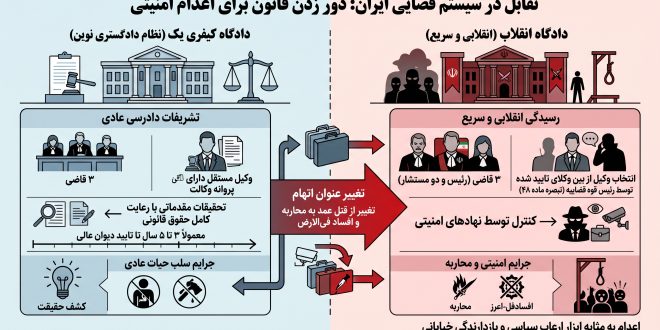
Iran has one of the highest execution rates in the world. Yet imposing a death sentence requires legal procedures and safeguards that can, in ordinary circumstances, slow the work of the security apparatus. This essay examines how the choice of charges and court can be used to work around those safeguards.
The judicial system and its roots
In 1927, Ali-Akbar Davar laid the foundations of Iran’s modern judiciary, drawing on the French judicial system. After the Islamic Republic was established, many laws were rewritten, but much of the judiciary’s administrative structure survived. Despite its many shortcomings, that bureaucracy does not always operate with the speed and “revolutionary decisiveness” demanded by those in power. Understanding the resulting tensions begins with the structure of the criminal courts.
Iranian courts broadly distinguish civil from criminal matters. Serious offences punishable by death, including murder subject to qisas—retribution in kind—ordinarily fall within the jurisdiction of Criminal Court One, subject to statutory exceptions. Its structure provides for a presiding judge and two associate judges, and capital cases involve procedural safeguards and Supreme Court review. Ordinary murder proceedings can take years.
Security bodies seeking a rapid response to protests have a different timetable. Arrest, trial and punishment can become instruments of public intimidation. It is here that the Revolutionary Courts enter the picture.
What makes the Revolutionary Courts different?
The Revolutionary Courts were established in March 1979 and began operating under figures such as Sadegh Khalkhali. One historic distinction was the number of judges: for many years, a Revolutionary Court could impose the gravest penalties through a single judge, while serious criminal proceedings elsewhere used panels.
That concentration of power meant that a case could depend on one person’s judgment. During the period when provincial criminal courts used panels of three or five judges, Revolutionary Courts continued to hear capital cases involving national security, drug offences, moharebeh—often translated as “enmity against God”—and efsad-e fel-arz, or “corruption on earth”, before a single judge.
The Criminal Procedure Code that took effect in 2015 introduced multi-judge proceedings for certain serious cases in Revolutionary Courts. Other differences remained, however, particularly concerning access to a lawyer of the defendant’s own choosing.
The note to Article 48 of the Criminal Procedure Code restricts the choice of counsel at the preliminary investigation stage in specified national-security and organised-crime cases. Parties must select from lawyers approved by the head of the judiciary.[1]
In law, that restriction concerns the preliminary investigation. My criticism is that, in practice, restrictions on freely chosen counsel can extend beyond that stage. Crucially, the investigation is also when the principal evidence against a defendant is assembled, sometimes while the defendant is isolated and under intense pressure.
Consider an ordinary citizen accused of “corruption on earth”, with little legal knowledge and no meaningful freedom to choose a lawyer. The distinction between having a lawyer on paper and receiving an independent defence becomes decisive.
The Persian article cites an interview in which the family of Majid Adineh alleged that an appointed lawyer travelled to Karbala during the proceedings and threatened that publicity could lead to the defendant’s execution. That is the family’s allegation, rather than an independently established finding. The interview cited in the original article illustrates the concerns raised about the quality and independence of representation.
Beyond formal rules lies the selection of judges. The Revolutionary Courts emerged from a political movement that regarded ordinary courts as excessively constrained by legal procedure. My argument is that ideological loyalty and alignment with security institutions have undermined their role as independent tribunals.
Two cases that illustrate the problem
The death of Ruhollah Ajamian
A gathering marking the fortieth day after Hadis Najafi’s death in Karaj led to street clashes. Ruhollah Ajamian, a member of the Basij, died from his injuries.
Even if the official account is accepted for the purpose of argument, the underlying allegation concerned a killing. A murder prosecution would engage the rules of the ordinary criminal courts, including the procedural and substantive requirements governing qisas.
Where several people are held responsible for a single murder, executing more than one can involve additional compensation requirements under the rules of diya, commonly translated as blood money. Those requirements complicate any attempt to impose several executions quickly.
My contention is that the use of security charges such as “corruption on earth”, and referral to a Revolutionary Court, provided a route around safeguards associated with an ordinary murder prosecution. The legal classification was therefore far more than a matter of terminology: it shaped the forum, the defence and the possible punishment.
Kian Pirfalak and Mojahed Kourkour
In the case concerning the killing of Kian Pirfalak in Izeh, his family publicly rejected the allegation that Mojahed Kourkour had killed their child and said they had no complaint against him.
That matters because qisas for murder depends on legal conditions that include the position of the victim’s heirs. Article 612 addresses imprisonment in certain intentional-homicide cases in which qisas is not carried out; it should not be treated as a complete account of every charge or every victim in a complex case.
The concern raised here is that charging “enmity against God” or “corruption on earth” supplies a separate route to a death sentence through the Revolutionary Courts. It allows the prosecution to pursue capital punishment without relying solely on the family’s demand for qisas.
Why the choice of court matters
These cases raise a broader question about the manipulation of jurisdiction. By framing allegations as security offences and taking them to Revolutionary Courts, the authorities can change the protections that operate in practice and the conditions under which a death sentence becomes possible.
My criticism is that this turns execution from the outcome of a careful search for truth into an instrument of political intimidation. A justice system should establish individual responsibility through independent proceedings, meaningful access to counsel and effective review. The seriousness of an allegation makes those safeguards more necessary, not less.
Note
[1] The note to Article 48 provides, in substance, that in offences against internal or external security and specified organised crimes falling within Article 302, the parties must choose their lawyers during preliminary investigations from among practising lawyers approved by the head of the judiciary. The names of those lawyers are announced by the head of the judiciary.This English adaptation clarifies legal terminology for readers unfamiliar with Iran and qualifies categorical statements in the Persian text. It presents the author’s analysis rather than legal advice.